Meesho assigns the courier and prints the label for you. Everything before that pickup scan is on you, and learning how to pack orders for Meesho shipping properly is the cheapest insurance you have against avoidable losses. Fashion and home categories on Meesho see return and RTO rates of 25 to 40 percent, and a parcel that arrives crushed or open turns into a customer return, a refunded order, and shipping charged both ways. A saree seller in Surat shipping 30 orders a day cannot afford three of them coming back because the poly bag split in transit, or because the barcode smudged and the parcel sat undelivered at a hub for a week.
This guide covers how to pack orders for Meesho shipping the way the platform expects: which material to use for each product type, how to attach the Meesho label and tax invoice so the barcode scans first time, how to hand parcels over through Shiprocket once you sell on more than one channel, and the packing mistakes that trigger Meesho packaging-quality penalties.
For most Meesho sellers shipping apparel and unbreakable goods, use 51-micron tamper-proof poly courier bags with the invoice in a stuck-on running pouch. Fragile or boxed items need a 3-ply corrugated box with at least 2 cm of cushioning on every side. Once daily orders cross 10 and you also sell off Meesho, book pickups through Shiprocket instead of handling couriers one by one.
This post contains affiliate links. If you buy through them, we may earn a commission at no extra cost to you.
How to Pack Orders for Meesho Shipping: Material by Product Type
| Material | Best For | Typical Cost (₹) | Rating |
|---|---|---|---|
| Tamper-proof poly courier bag (51 micron) | Apparel, sarees, textiles, unbreakables | ₹1.5–3 per bag | 4.6/5 |
| 3-ply corrugated box | Cosmetics, small electronics, light fragile | ₹8–18 per box | 4.5/5 |
| 5-ply corrugated box | Heavy or high-value fragile items | ₹22–45 per box | 4.3/5 |
| Bubble wrap / air-cushion film | Wrapping and void fill for fragile goods | ₹4–9 per parcel | 4.4/5 |
| Transparent running pouch | Holding the label and invoice outside the parcel | ₹0.5–1 per pouch | 4.7/5 |
Tamper-Proof Poly Courier Bags
These are the default for Meesho. A self-sealing poly courier bag with a permanent adhesive strip and a document pocket, in 51 or 60 micron thickness. Meesho’s packaging guidelines specifically ask for tamper-evident packaging with a pouch for the label, and ordinary polythene bags or newspaper wrapping are a common reason parcels get marked down on packaging quality after a return.
Buy them sized to your product. A single kurta fits a 10×12 inch bag; a saree set needs 12×16 inch. Do not oversize, because Meesho bills you on volumetric weight when it is higher than actual weight, and a half-empty bag inflates the dimensions. Fold the garment flat, slide it in, remove excess air, then press the seal along its full length. For orders above 500 grams, add a strip of packing tape over the seal as insurance. At ₹1.5 to ₹3 a bag in bulk from a local packaging supplier in Rajkot, Delhi, or Ahmedabad, this is the cheapest reliable option for anything that cannot break.
Corrugated Boxes for Fragile Orders
Anything that can crack, dent, or leak goes in a corrugated box, not a bag. A 3-ply box handles products up to about 5 kg such as a boxed watch, a ceramic mug set, or a bottle of hair oil. Go to 5-ply for heavier items or anything you would be upset to see returned broken, because 5-ply resists crushing when parcels are stacked in the courier hub.
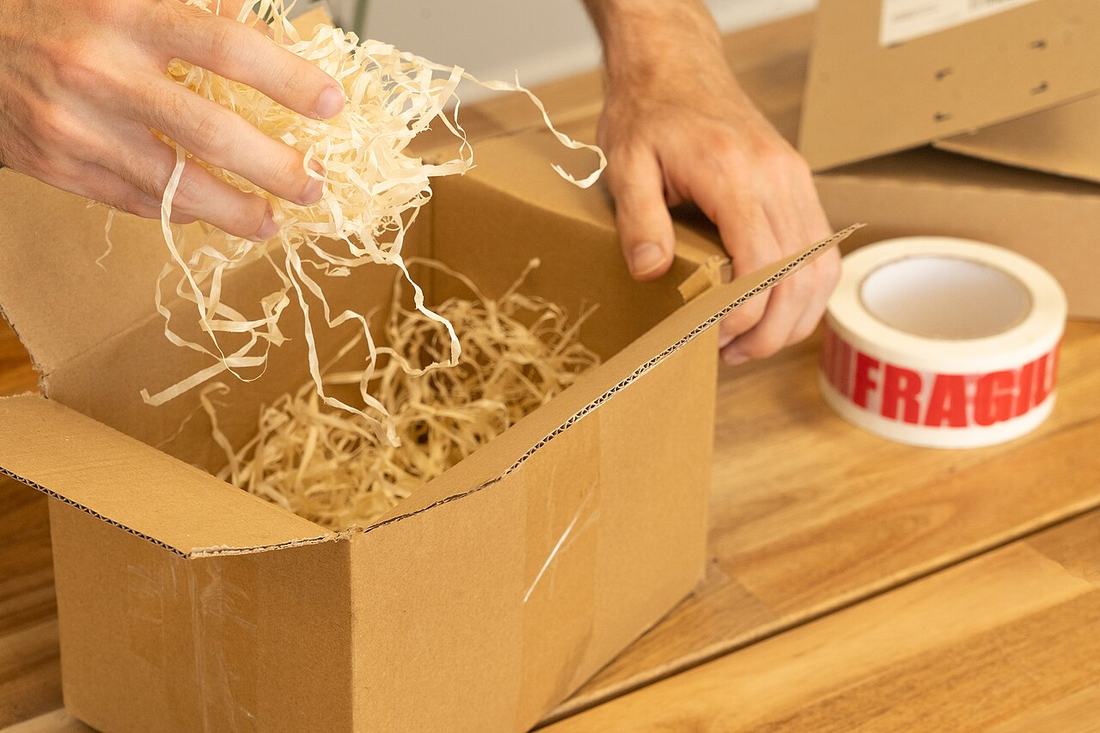
Pick a box roughly 4 cm larger than the product on every axis so there is room for cushioning. Wrap the item in two layers of bubble wrap, seat it in the centre, and fill every gap with air pillows, crushed paper, or more bubble wrap until nothing shifts. Do the shake test: seal the box, shake it near your ear, and if you hear or feel movement, add more filler. Tape all seams with the H-pattern using 48 mm packing tape. A boxed order in Coimbatore that rattles when the delivery partner picks it up is an order you will likely see again.
Attaching the Meesho Label and Invoice
From the Meesho Supplier Panel, open Orders, then Ready to Ship, and download the label. Meesho generates the shipping label and the tax invoice together as one PDF. Print it, cut the shipping label portion, and stick it flat on the largest face of the parcel with no tape running across the barcode, because tape glare makes the scanner fail at the hub and delays the parcel.
The tax invoice must travel with the order. Put it inside the parcel, or fold it into a transparent running pouch stuck next to the label. Keep the label uncreased and fully visible. If you reuse a box, black out or remove every old label and barcode first, because a scanner that reads the wrong code sends your parcel to the wrong city. Print at the largest size that fits; a label smaller than 4×6 inches is harder for hub staff to scan quickly. If you use a thermal printer, check that the print is dark and even before the roll runs low, since a faint barcode fails just as often as a taped-over one.
Using Shiprocket for Pickup and Dispatch
If you only sell on Meesho, its managed courier books your pickup automatically and you can skip this. The moment you add a second channel, such as your own website, an Instagram shop, or a WhatsApp catalogue, handling each courier separately becomes the bottleneck. Shiprocket puts 17-plus courier partners behind one dashboard, picks the cheapest serviceable option per pincode, prints labels in bulk, and manages NDR follow-ups when a delivery fails. The basic plan has no monthly fee; you pay per shipment based on weight and zone.
One honest limitation: weight-discrepancy disputes, where the courier logs your 480-gram parcel as 1 kg, can take 7 to 10 working days to resolve, and the disputed amount is held against your wallet until then. Weigh and measure every parcel yourself and keep a photo, so you can contest charges with evidence.
Who Should Skip This
If you sell only on Meesho, ship under five orders a day, and stock only apparel, you do not need corrugated boxes or a shipping aggregator. A stack of tamper-proof poly bags, a roll of running pouches, and Meesho’s built-in courier pickup cover everything. Adding boxes, filler, and a Shiprocket account before you have the volume just ties up cash in packaging inventory that sits in a corner. Scale the setup when the order count forces it, not before.
FAQ
Does Meesho provide packaging material?
No. Meesho assigns the courier and generates the label and invoice PDF, but you buy and apply all packaging yourself. It has to be tamper-evident, so plain polythene bags are not acceptable.
Can I use a normal plastic bag for Meesho orders?
No. Meesho requires tamper-proof courier bags with a sealed adhesive strip. Ordinary polybags or paper wrapping can trigger packaging-quality penalties and make disputed returns harder to contest.
Where does the invoice go in a Meesho parcel?
Inside the parcel, or in a transparent running pouch stuck on the outside next to the shipping label. The Meesho label and the tax invoice print together as a single PDF from the supplier panel.
Do I need Shiprocket if I sell on Meesho?
Not for Meesho-only orders, since Meesho’s managed courier handles pickup. Shiprocket becomes useful once you also ship from your own site, Instagram, or a WhatsApp catalogue and want one dashboard for every courier.
This post contains affiliate links. If you buy through them, we may earn a commission at no extra cost to you.
Image credits: Featured image: Meanwell Packaging / Wikimedia Commons, CC BY 2.0. In-body image: Jemimus / Wikimedia Commons, CC BY 2.0.